

Gold, copper and rare earth metals: the materials hiding inside Britain’s retired business IT assets
In 2025, almost 1,590 tonnes of material passed through our processing and recovery streams. This International E-Waste Day highlights the growing volume of technology reaching the end of its life.
By S2S Group, October 2026
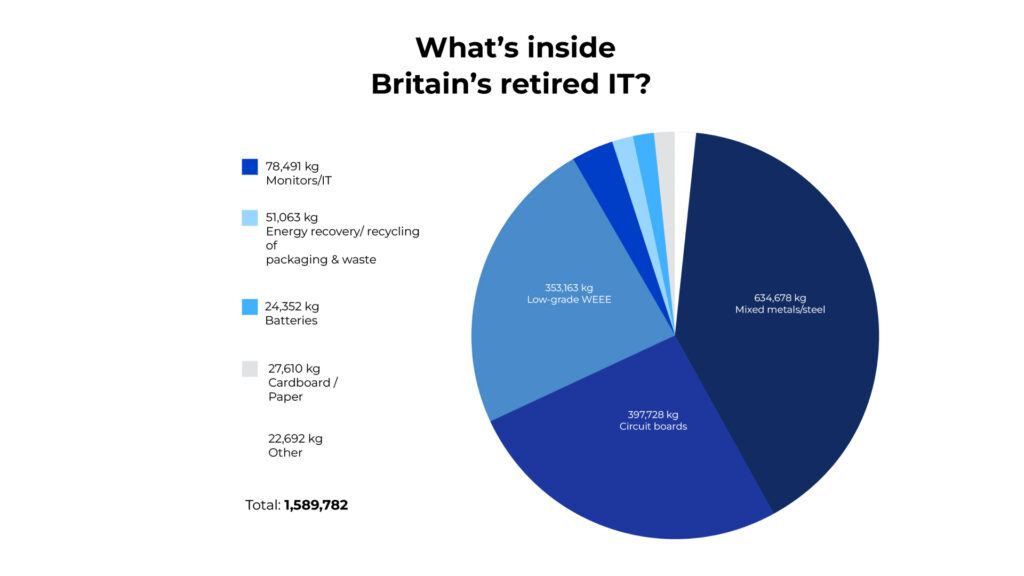
The figure – equivalent to the weight of around 1,000 cars – reveals the scale and variety of materials contained within Britain’s retired business IT, from steel, aluminium and copper to batteries, circuit boards and small quantities of precious and critical materials.
This year’s International E-Waste Day, on 14 October, focuses on ‘Fast Tech’ – the rapid growth of low-cost electronic products designed, bought and discarded at an increasingly fast pace.
The theme also highlights a wider challenge for the technology industry: as demand for new devices and digital infrastructure grows, so does demand for the finite and critical materials needed to make them.
Our figures show that significant quantities of these materials are already contained within technology being removed from service by businesses. The largest material stream to pass through our specialist processing was mixed metals and steel, accounting for around one in every three kilograms processed.
This was followed by 398 tonnes of circuit boards and 353.2 tonnes of low-grade Waste Electrical and Electronic Equipment (WEEE) such as power cords.
A further 222 tonnes of shredded circuit boards and hard drives were sent for specialist refining. These materials can contain aluminium, copper, steel and other metals, alongside plastics, glass and small quantities of precious and critical materials including gold, silver, palladium, cobalt and rare earth metals.
Our CEO, Grant Barton, said: “When people think about retired IT, they often picture old laptops, computers and servers. What is less obvious is the sheer variety of materials contained within them – a complex mix of industrial metals, electronics, batteries and small quantities of precious and critical materials. With demand for these finite resources increasing, it’s important that we recover as much value as possible.
“However, this isn’t as simple as extracting materials during initial processing. Different assets require different approaches, from secure data destruction and reuse to specialist downstream recovery. It’s about looking beyond disposal to protect data, maximise reuse and recover valuable materials.”
These figures underline why businesses need to consider what happens to their IT estate before equipment reaches the end of its working life. Secure data destruction, reuse and appropriate material recovery all form part of responsible IT asset management, helping organisations reduce waste while ensuring valuable materials remain within the recovery chain.
As International E-Waste Day asks consumers and organisations to think differently about the growing volume of electronics being discarded, we’re calling on businesses to do the same with their retired IT.
Businesses reviewing, replacing or disposing of IT equipment can speak to our experts about secure IT asset disposition, data destruction, reuse and responsible material recovery.